
I Secured 9 Rooms (For Us) In An Already Operational Ramada Airport Hotel
A couple of months back, I invited you to participate in a Ramada hotel project in Paraguay that my partner, Markus, brought exclusively to us.Just...
12 min read
Mikkel Thorup
:
Aug 24 2026
A couple of months back, I invited you to participate in a Ramada hotel project in Paraguay that my partner, Markus, brought exclusively to us.
Just as we were breaking ground, nine rooms remained, so I sent you guys a newsletter explaining the investment thesis…
What remained sold out within weeks.
When we first launched that project, there were 68 rooms… and ultimately, every single one was purchased through the Expat Money & Paraguay Potential communities.
I mention that because today I have a separate Ramada opportunity to discuss with you, and rather amusingly, I once again have exactly nine rooms available.
There is one very important difference this time…
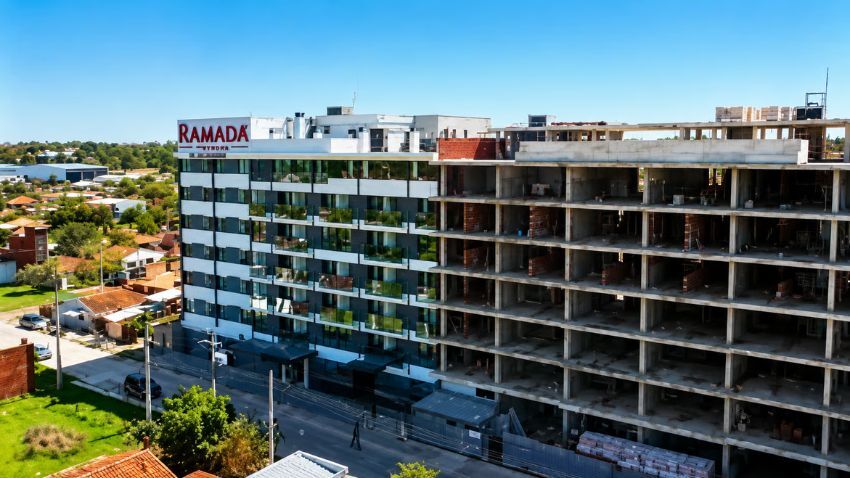
This Ramada is already operational…
…and they are expanding the hotel to include a total of 200 rooms.

70 rooms are already filled by guests, and 130 more are under construction, with targeted completion set for 6 months from now.
All of those 130 rooms are sold out.
But stick with me…
…just because these 130 units are completely sold out and unavailable to the general public, doesn’t mean we don’t have access…
The Ramada Suites by Wyndham Asunción Aeropuerto is located just across the runway from Silvio Pettirossi International Airport (ASU), and according to Markus's partners from the local Wyndham operating group, the hotel's existing 70-room inventory is completely sold out through the end of 2026.
The demand has become strong enough that the hotel is now expanding its room inventory.

Many of you already know my trusted partner, Markus Amann.
He is one of my closest partners on the ground in Paraguay, and he is also a substantial landowner in the country who has been involved in some of the region's most important, large-scale residential projects.
Recently, Markus sold a piece of his land holdings to the Wyndham Partner Group for a project being built in Nueva Asunción, and as part of the deal, he opted to receive payment in 19 rooms inside this Ramada Airport hotel in lieu of cash.
Markus knows the Paraguayan market exceptionally well, works directly with the people developing these projects (when he isn't doubling as the builder), and, when structuring the sale of his land, he opted to receive compensation in the form of hotel real estate.
…if that doesn’t speak to his confidence in the project and the market as a whole, I’m not sure what does…
Now, after a fair bit of pushing on my part, he has agreed to release nine of them exclusively to us.
Markus is not exiting his position in the Ramada Airport project completely.
He is keeping the other ten.
Nine rooms. That's our inventory.
If you've been reading Paraguay Potential for a while, you know I pay enormous attention to infrastructure growth.
Infrastructure tells you where governments and private capital expect people, businesses, and economic activity to move… often before much of that growth is reflected in asset prices.
…and right now, the area surrounding Paraguay's international airport is undergoing an extraordinary amount of infrastructure development.
One of the most important projects is a major overhaul of Route D025 that is set to improve one of the principal highways between the airport terminal area and Asunción.
The project is expanding approximately 4.4 kilometres of Route D025 from two lanes to four.
Construction is happening right now.
It is estimated that once completed (Q1 2027), the increased roadway will directly benefit upwards of 500,000 people every day
So while the new hotel rooms are expected to finish in roughly six months, one of the most important transportation corridors around them will also be moving toward completion around the same time.
…and that isn't the only major road project underway.
In January of this year, Paraguay began another enormous $175 million infrastructure program designed to change how traffic enters and exits Greater Asunción.
One of its centrepieces will be a 3.6-kilometre elevated urban highway with two lanes in each direction.
When completed, it will be Paraguay's longest elevated highway.
Take a moment and consider what is happening here.
The government isn't simply repaving the road outside an airport - it is strategically increasing the amount of traffic that can move through one of the most important transportation corridors in the Greater Asunción area.
All roads (pun intended) are increasingly leading toward the airport and its surrounding region as Paraguay prepares for more passengers.
Silvio Pettirossi International Airport (ASU) handled more than 1.3 million passengers in 2025; its highest figure ever recorded and an increase of nearly 10% from the previous year.
That growth can be attributed partly to increased connectivity, additional airlines offering service, and Paraguay's growing importance as a destination for business, investment and international events.
In the last year alone, new routes and additional frequencies have been announced connecting Asunción with markets across Argentina, Brazil and other parts of South America.
Today, you can fly nonstop from Asunción to Madrid, Panama City, Bogotá, Lima, Santiago and São Paulo (in addition to an expanding network of other lesser-known international destinations).
Passenger traffic is already setting records, and the aviation network required to support the next stage of that growth is expanding alongside it.
Every additional airline, route and flight creates another stream of people moving through the airport corridor.
Some will never need a hotel room.
Plenty will.
Silvio Pettirossi International (ASU) itself is now being upgraded in response to that growth.
Late last year, a new 2,245-square-metre boarding area opened, doubling the number of security checkpoints and adding passenger boarding bridges (the elevated corridors that connect the airline gates to the airplanes on the tarmac).
…but the longer-term plans go considerably further.
I have it on good insider authority that an entirely new second passenger terminal will be put out to tender, with longer-term plans for Terminal 2 designed to increase capacity to an eventual 4 million passengers annually.
You have to look at these developments together, not individually.
Passenger traffic, airport capacity, road infrastructure and international connectivity are all moving in the same direction.
…and just in front of the airport runway, an existing Ramada is expanding because its current inventory is already experiencing exceptional demand.

Part of the reason for these improvements is the role Paraguay will play in the 2030 FIFA World Cup.
Though the bulk of the tournament will take place in Spain, Portugal and Morocco, FIFA has chosen to bring part of the tournament back to South America for its 100-year celebration.
Uruguay, Argentina and Paraguay will each host one of those historic matches, meaning Paraguay will officially become a World Cup host country in 2030.
I don't want to overstate what that means for this investment.
A hotel needs to make sense during ordinary years, not because the world's largest sporting event comes to town for a few days.
Fortunately, this one already does.
What makes FIFA 2030 particularly relevant is the infrastructure investment required to prepare for it.
As part of the host evaluation process, FIFA assessed Paraguay's transportation and airport infrastructure and specifically identified Silvio Pettirossi International as needing substantially greater passenger capacity, as it currently falls short of the requirements.
The World Cup coming to Paraguay should not be mistaken as a major part of the thesis we are discussing today; however, I am mentioning it because it is helping accelerate the infrastructure upgrades Paraguay already needs
In my eyes, this “FIFA push” is a nice little cherry on top of the much broader and far more durable investment thesis that already exists.
Asunción currently has roughly 9,000 hotel beds, and the Paraguayan hotel industry expects that figure to increase toward approximately 10,000 by 2030 as the country prepares for continued growth in business travel, tourism, conferences, international events and investment activity.
That means roughly 1,000 additional beds are expected to enter the market over the next several years.
Much of that expansion is coming from some very recognizable names (including other Wyndham group properties separate from the Ramada brand).
Some people might look at another 1,000 hotel beds coming onto the market and immediately think “competition.”
I look at it differently.
International hotel companies don't deploy millions of dollars into new properties without being extremely confident in the demand they expect to find there.
They study passenger growth, corporate travel, tourism, infrastructure, room rates, occupancy and expanding business activity before deciding where the next wave of hotel demand is likely to emerge.
Some of the world's largest hospitality groups are reaching the same conclusion: Paraguay needs more hotel inventory.
…and the numbers coming out of the hospitality industry help explain why...
Paraguay's hotel industry reported 43% growth during the first half of 2026, while the average daily room rate in Asunción reached approximately $95.76 USD.
(Keep that second number in the back of your mind because we're going to get into the financials of our Ramada Airport opportunity shortly).
For now, all you need to know is that we are deliberately modelling this investment using an average nightly room rate of only $70 USD, more than $25 below the current Asunción average.
With roughly 1,000 additional hotel beds expected to enter the market, we're not assuming today's average room rate will continue indefinitely in the short term.
We're deliberately modelling this investment at $70 per night instead.
For now, the important point is that the hospitality industry is expanding because it expects considerably more people to need accommodation in Paraguay over the years ahead.
There is another reason I particularly like the economics of this hotel within that larger story.
A traditional hotel often has to convince somebody that its surrounding neighbourhood is where they want to spend their trip…
An airport hotel serves a much simpler need.
People have to use the airport.
Pilots and cabin crews need somewhere to sleep.
Business travellers arrive late and leave early.
Conference attendees move in and out of the city.
International travellers have overnight layovers.
For an international traveller landing in Paraguay, familiarity matters.
Corporate travel departments know Wyndham.
Airlines know Wyndham.
Travellers know what they will receive when choosing a well-established international hotel brand like Ramada.
That recognition becomes particularly valuable when a substantial portion of your customer base is arriving from another country.
The investment structure is straightforward.
You purchase titled real estate, meaning you legally own an individual hotel room through a standard real estate purchase agreement, while also entering into a 20-year operating agreement with the local Wyndham partner that operates the hotel.
They operate the hotel, manage the staff, handle marketing and reservations, and take care of cleaning, utilities, insurance, maintenance and virtually everything else operationally.
You receive quarterly reporting and quarterly distributions of your income under the operating agreement.
Your job is not to run a hotel.
Your job is to own the underlying real estate and share in its performance.
Just like the last Ramada project I brought to you guys, this Airport Ramada operates under a pooled ownership model.
That means your return isn't determined by whether the specific room you own happened to be occupied on any particular night; the rooms are standardized, revenue is pooled according to the operating structure, and what ultimately matters to you is the performance of the hotel as a whole.
Obviously, we're not going to model a hotel investment on the assumption that today's extraordinary occupancy continues indefinitely.
There will be slower periods.
New hotel inventory is coming onto the market.
Total available inventory in the market will increase.
That's exactly why we're being prudent and conservative with our assumptions.
Our financial modelling assumes an average nightly room rate of approximately $70 USD and an annual occupancy rate of 75%.
…remember, the average daily room rate across Asunción is currently closer to $95 USD, so we're deliberately modelling this property at a considerably lower price point as additional hotel inventory enters the market…
At approximately $70 per night, this Ramada is positioned to compete aggressively for guests while still offering the familiarity and standards of an internationally recognized Wyndham brand.
Add the hotel's proximity to Paraguay's primary international airport, growing passenger traffic, its appeal to airline personnel and business travellers, and the wider amenities on the property, and I think 75% occupancy is a very reasonable assumption to model around.
Could occupancy be higher?
Absolutely.
But we don't need it to be… and truthfully, I think anywhere between 75% and 80% occupancy is where we will land on an annual year-over-year basis.
Under our conservative assumptions, projected annual distributions from room revenue alone work out to 12%+, net.
…and that is before we add in the roughly 1% in additional annual return expected from the owners' share of ancillary hotel revenue (food and beverage sales, parking revenue, conference room rentals).
NOTE: The Airport Ramada includes a casino; however, gambling profits are not part of the operating agreement, and you will not share in the wins (or losses) generated.
All other ancillary profits are.
If passenger numbers keep increasing, the airport continues expanding, road access improves, international connectivity grows, and the entire corridor becomes more commercially important, I think it is perfectly reasonable to believe that well-positioned hotel real estate inside that ecosystem could become considerably more valuable in the medium-long term, which would result in increased occupancy and higher nightly rates.
That said, for the sake of ease and clarity, I am not going to play around with an anticipated appreciation percentage in this edition of Paraguay Potential.
The yield is attractive enough to justify looking at the investment on its own under our current projections.
Of the nine rooms Markus has agreed to release to our community, you have two options.
One Single Titled Hotel Room: $95,000 USD
Three-Room Titled Block: 265,000 USD (effective price per room of $88,333 USD).
Let's walk through the return calculation so you can see exactly where the numbers come from.
The breakdown I'm about to show you already accounts for Wyndham's local operating partner share, which averages 40% (you receive the remaining 60%).
$95,000 invested → $11,500 annually to you → 12.1% projected annual return.
…and remember, that's after the operator's 40% share has already been accounted for.
$265,000 invested → $34,500 annually to you → 13% projected annual return.
Again - the respective 12.1% and 13% figures above are based on room revenue alone and already account for the operator taking its 40% share, and they DO NOT include the additional shared revenue owners are expected to receive from the hotel's restaurants, parking, and other ancillary revenue, which is projected to contribute roughly another 1% annually.
Now… at $70 per night, 75% occupancy and after the 40% operating split, the underlying room economics already work incredibly well.
But what if we have a slower year?
Let's stress-test it and knock the occupancy rate down to 65%.
Keep the room rate at the same conservative $70 per night, keep the operator's 40% share, and change absolutely nothing else.
…remember, we’re already modelling the nightly rate substantially below the roughly $95 average currently being reported across Asunción.
We can take our occupancy assumption from 75% down to 65%, and the model still produces a projected return of roughly 10.5% on one room and 11.3% on the three-room package.
Hotel performance will fluctuate, and there will inevitably be stronger and weaker periods.
But this is exactly why I like running the numbers under less favourable assumptions before putting my own capital to work.
We don't need today's extraordinary occupancy to continue forever.
We don't need today's average Asunción room rate to hold.
We don't even need our primary 75% occupancy assumption to be bang on every year.
The numbers still give us considerable room for compelling hands-off returns, even in years when the occupancy rate dips.
Another useful way to look at the economics is how quickly the income distributed to you could cumulatively equal your original investment.
At approximately $11,500 in annual distributions to you, a $95,000 individual room has a simple payback period of roughly 8.3 years.
At approximately $34,500 in annual distributions to you, the $265,000 three-room package has a simple payback period of approximately 7.7 years.
Assuming those returns hold, somewhere around year eight, the cumulative income distributed to you under the terms of the operating agreement would have paid back an amount equal to your entire original investment.
…all the while, you still own the real estate, and there are still roughly 12 years remaining on the term…
Those years are effectively generating you pure profit as you have already recouped your principal investment.
On the three-room package, that would mean you would be receiving more than more than $400,000 in additional distributions over the remainder of the initial 20-year term.
$34,482 annually x 12 years = $413,784.
AND…
At the end of the operating agreement, YOU STILL OWN THE ASSET.
Maybe Ramada opts to offer a new agreement to existing owners.
Maybe another hotel brand does.
Maybe they get converted into apartments, and you then seek out a long-term tenant or place your property into the short-term rental market.
By that point, you will have already realized hundreds of thousands of dollars in profit, and the underlying airport-adjacent real estate in a high-growth market will still be yours.
*The numbers used above to generate the financial projections were supplied to us in good faith by the Wyndham Operating Partner in Paraguay.
The 20-year operating agreement does not mean you're prohibited from selling your property for 20 years.
You can sell your room whenever you choose.
However, a legally binding condition will be attached to the resale.
Because the hotel operates as a professionally managed, pooled property, the room must remain inside the hotel rental program, meaning any future buyer must agree, as a condition of purchasing your titled unit, to continue participating in the rental program with Wyndham's local operating partner under the agreed-upon terms.
In other words, you can't sell the room to someone who decides they would rather move in permanently, pull it out of the hotel inventory and use it as their private apartment.
I actually think that restriction makes a great deal of sense.
The entire investment model depends on maintaining a standardized pool of professionally operated hotel inventory, rather than having individual owners slowly remove rooms, change how they're used, or compromise the hotel's consistent standards.
Markus received 19 rooms in a project that was already completely sold out.
He's keeping ten.
We have nine.
One room is $95,000 USD.
Three rooms are $265,000 USD.
The last time I had nine remaining Ramada rooms to discuss with this community, seven disappeared after the first newsletter, and the remaining two disappeared about a week later.
This time, I have nine again.
This time, we're talking about an operating hotel that is already expanding to meet demand, inside an airport corridor receiving enormous infrastructure investment, with the numbers still working under deliberately conservative assumptions.
…I think you can understand why I pushed Markus to give us access…
If you want to secure an individual room for $95,000 USD, or discuss taking down one of the three-room blocks for $265,000 USD, reach out to Markus immediately by scanning one of the two QR codes so you can connect with Markus directly via Telegram or WhatsApp.
Mark my words.
These won’t last long.
If you want in, you have to connect with Markus immediately, either by scanning one of the QR codes above (preferred method) or by emailing Expat@Paam.com.py so you two can handle any additional questions you may have about securing a position at the new Airport Ramada.
I will write you guys within the next two weeks; however, I highly suspect that when I do, it will be to tell you that far fewer than nine rooms will be available… if there are any left at all.
Regardless, you can expect an update from me within the next two weeks.
Speak soon,
Mikkel
PS. All investments contain risk, including the risk of losing your principal. Nothing in life is guaranteed. Is this outcome likely? Absolutely not. But again, nothing in life is guaranteed.
Paraguay Potential is your go-to source for uncovering the immense opportunities in one of South America’s most promising investment destinations. With its business-friendly environment, low taxes, and favourable government, Paraguay is quickly becoming a top choice for investors seeking growth and stability. For those who have already invested in one of the projects we have underway, we provide detailed construction updates to keep you informed on progress every step of the way.
Paraguay Potential is the perfect place for those who are looking to gain the tools and knowledge to maximize their investment in this high-growth region.
A couple of months back, I invited you to participate in a Ramada hotel project in Paraguay that my partner, Markus, brought exclusively to us.Just...
For a long time, Paraguay was not on the radar of many as a high-upside Plan-B jurisdiction.
I went to Paraguay several years ago to sit down with my now-business partner, Markus Amann, so he could walk me through a very promising...